
Report: AI-Assisted API Design
Reduce API design from hours to minutes with LLMs as your assistant. Download our free 78-page report on AI-Assisted API design.

The definitive guide to using Large Language Models (LLMs) as an API Design Coach, not just a code generator.
The traditional API design process today is bottlenecked by limited time and budgets, forcing teams to choose between delivery speed and design quality.
This “rush to code” introduces significant technical debt and fails to support the agility required for modern AI strategies.
This report reveals a game-changing shift: using LLMs as interactive API design coaches, paired with the proven ADDR framework (Align → Define → Design → Refine).
Authored by James Higginbotham, API strategist at LaunchAny and creator of the ADDR process, this 78-page guide draws from real data to show how teams cut sessions from 1-2 days to less than an hour while improving OpenAPI quality and reuse.
The “Rush to Code” is creating technical debt. It’s time for a new approach.
Traditional API design is bottlenecked. Limited time and budgets force teams to choose between speed and quality.
But what if you could reduce design efforts from 44 hours to 2.8 hours without sacrificing the developer experience?
This report found that it is possible to reduce the time to design great APIs using LLMs, leaving API designers in charge of the process while reducing the amount of manual effort required to design and share your API designs for faster feedback cycles.
You stay in charge throughout the whole process.
Plus, if you are new to ADDR, the LLM can provide helpful coaching hints to guide you through the entire ADDR design effort.
What You Will Learn
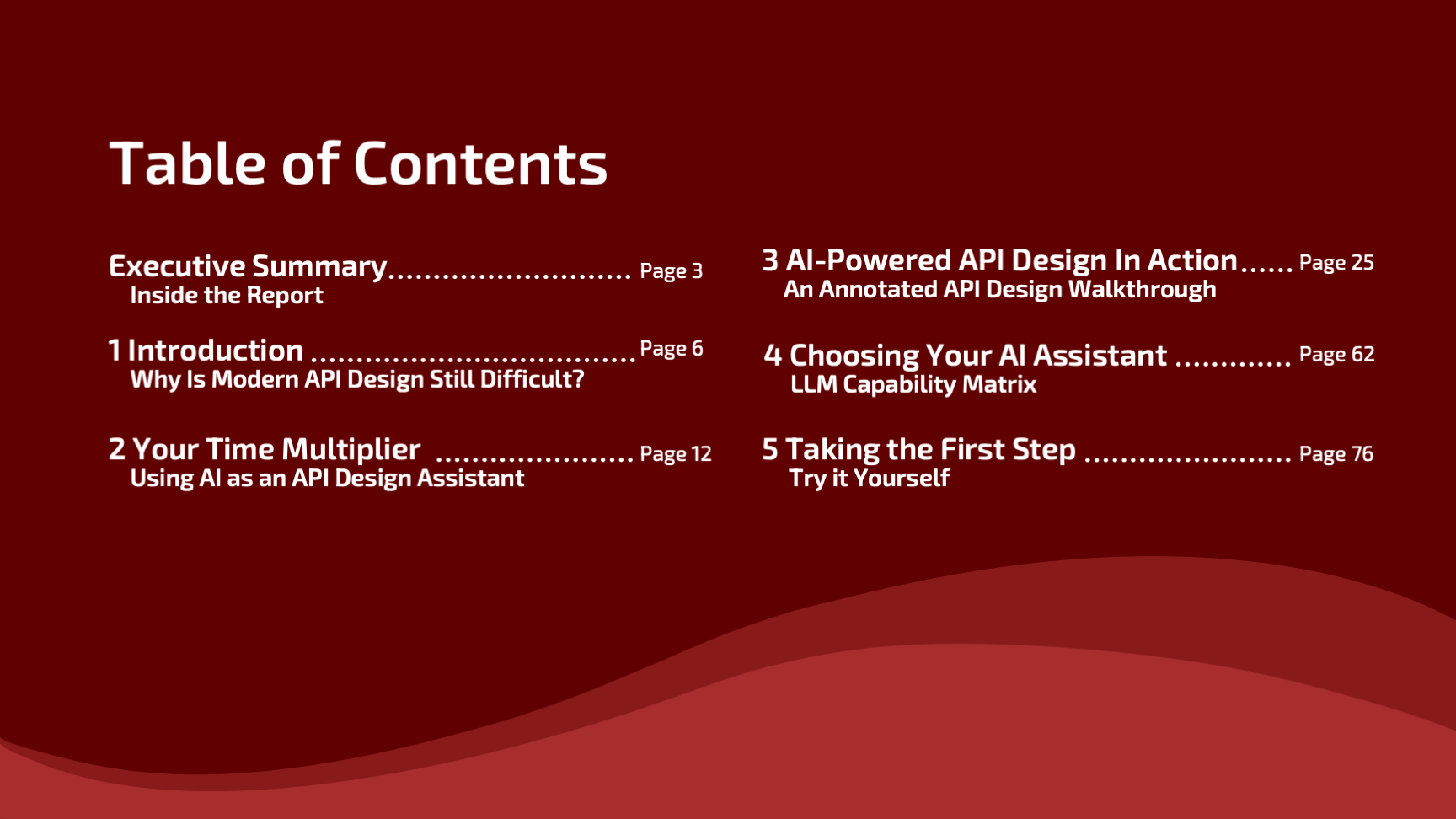
1. The Shift: From Writer to Reviewer - Learn how to use LLMs to perform the heavy lifting of artifact creation so you can focus on aligning business goals with user outcomes.
2. The Methodology: ADDR + AI - We walk you through a complete, annotated design session using the ADDR process (Align, Define, Design, Refine). You will see:
- Align: How to turn requirements into Job Stories and Activity Steps.
- Define: How to use AI to identify ecosystem boundaries and cohesive API profiles.
- Design & Refine: How to auto-generate OpenAPI specifications and READMEs with >95% accuracy
3. The 2025 LLM Showdown - Not all models are ready for API design. We tested the leading models of late 2025 to see which can truly “coach” an API designer using the ADDR process. Findings include:
- Google Gemini 2.5 Pro & 3.0: Excellent domain modeling and coaching capabilities.
- OpenAI GPT-5: Deep research but missed the mark in a few areas that could impact your API design efforts.
- Microsoft Copilot with Smart GPT-5: Strong modeling capabilities but struggled to complete the full ADDR process in one session.
Plus detailed findings on Claude Sonnet 4.5 and Grok 4, prompt starters, and more.
Key Findings
- Drastic Time Reduction: AI-assisted workflows reduce API design time by 60% (and up to 20x faster in some phases) while improving consistency.
- High-Fidelity Artifacts: Critical deliverables—such as Job Stories and OpenAPI specifications—can now be auto-generated with >95% accuracy.
- Human-Centric Design: AI handles the heavy lifting of artifact creation, allowing the API designers to focus on aligning business goals with user outcomes. (“AI in the loop”)
- The Competitive Edge: Organizations that adopt AI-assisted API design in 2026 will outpace competitors not by writing code faster, but by making better architectural decisions faster..
Who Should Read the Report?
- Practitioners looking for a way to speed their API design efforts without sacrificing a great developer experience.
- API program leaders tired of low reuse and duplicate API efforts.
- AI transformation leaders that wish to expand their AI value creation beyond GenAI co-development.
Want help applying this to your systems?
Book a free 30-minute call to talk through where your platform stands today.

More reports
Integrating Enterprise Systems with AI and APIs
Bring existing and legacy systems into an AI-native organization with intent-based design and MCP.
Download the report →
The AI Tooling Landscape
How AI tooling specifications work, and how to choose between MCP and UTCP.
Download the report →